Be yourself; Everyone else is already taken.
— Oscar Wilde.
This is the first post on my new blog. I’m just getting this new blog going, so stay tuned for more. Subscribe below to get notified when I post new updates.
Be yourself; Everyone else is already taken.
— Oscar Wilde.
This is the first post on my new blog. I’m just getting this new blog going, so stay tuned for more. Subscribe below to get notified when I post new updates.
Brittany dogs are like small children, they have tons of energy, and they will demand that you play with them all the time. Daily walks are not enough to satisfy these dogs’ need for activity. They want you to engage in playtime, or they are not happy.
Brittany spaniels are a high-energy dog breed, but they generally calm down as they approach adulthood, so just before they are 12 months old, however, only slightly. Hyperactivity is part of their nature throughout their entire lives. These dogs can calm down indoors, but they will need to let off steam outdoors.
If you own a rambunctious Brittany Spaniel, undoubtedly, you want to explore ways to help your dog calm down. In this article, let’s explore ways of assisting owners in coping with such a dog. To better understand Brittany Spaniel, it helps to get a clearer picture of their personality and their breeds’ purpose.
The Brittany was initially bred as a hunting dog that originated in Brittany, France. It’s uncertain when this dog came to be, but the breed was immortalized in tapestries and paintings from the 17th century. Those artworks depict hunting scenes.
The Brittany Spaniel is also recorded in a hunting description from 1850 and written by Reverend Davies. His notes describe the breed as excellent retrievers and pointing dogs.
Brittany Spaniels are indeed a hyper breed. Their temperament is like that of a setter or pointer than a spaniel. They may have the appearance of a spaniel, but they have the spirit of a hunting dog. Hunting dogs have boisterous personalities, as it goes with the territory.
Brittany Spaniels desperately need an outlet for their energy. It would help if you took them out for long walks, hiking in the woods, and swimming. They need lots of engagement from their owners, as they thrive on the attention you give them.
An inactive lifestyle will only lead to excessive barking, hyperactivity, and destructive chewing. You must be sure that you can provide sufficient exercise and mental stimulation.
Aside from providing enough exercise, you might also consider enrolling your Brittany Spaniel in obedience training, tracking, and agility.
1. Don’t let him freely roam around your home
When you first bring your tiny buddy home, you must control his movements in your house. This means that you don’t allow him to wander around your house freely; he must understand that it is a privilege he must gradually earn.
Only when he is 100% housebroken, has learned all the rules, and is calm in your home can he have more liberty. Ensure that your home is puppy-proof, making sure that he is close to you at all times, even if that means keeping him on a leash.
If your dog isn’t housebroken, you need to keep him in a pen or crate when you’re busy and can’t interact with him.
2. Encourage calmness
You must instill both mental and physical calmness in your puppy. When you’re not with him, you must keep him safely confined to a pen or a crate.
Teach Yes and No. He must learn to walk nicely and wait at gates and doors rather than rushing through. It would be best if you taught him the Sit and Stay commands.
When your Brittany puppy disobeys your commands, correct him, however, gently. If you are too harsh with him, he will become more fearful and difficult, as these dogs are sensitive.
Ensure that you and your household are calm, and be mindful not to have loud music playing or the TV blaring
3. Using the reward system
You can use rewards such as a toy or treat as an incentive for your puppy to obey your commands. Brittany Spaniels are known to jump on people, bark, and chase other animals. Do not reward such behavior; instead, correct your dog; be firm but not harsh.
When your buddy displays good behavior such as standing still when you brush him, going to the bathroom in the right place, and treating guests politely, you must reward such behavior and offer praise. Offer a treat or a toy and lots of praise.
4. Provide daily opportunities for exercise and activity
It would be best to equip your new family member with an active lifestyle to channel their boundless energy. This dog breed is excitable, but they have many excellent traits that need nurturing to bring out their best.
You can get your Brittany Spaniel to calm down indoors eventually, but you must tire out your buddy. We are talking about at least two walks a day for about thirty minutes.
Other activities like swimming, running, hiking, and playing fetch will exhaust him so much that he is sure to be calm at home.
5. Practice early socialization
Brittany Spaniels can become excellent family pets that are polite and gentle with everyone, including other animals and strangers; however, they need early socialization.
Your Brittany puppy needs plenty of exposure to people, other dogs, unfamiliar sights, and noises from day one. This will nurture your dog’s softness without making him shy, fearful, and overall unbearable to live with.
You can bring your Britt to a local dog park; naturally, it will be hard at first. Your puppy will be very nervous. Initially, bring your dog to the park, and if he can only handle a few minutes at a time, allow it.
You can gradually increase your time at the park, use your leash to control your dog, and stop him from attacking people and other dogs.
Use treats to reward his good behavior, encouraging him to keep up the good work. Eventually, he will love the dog park and seeing people and other dogs.
6. Be the leader
You must command respect from your puppy from the day you bring him home. Your Brittany Spaniel must see you as the leader of the pack.
Dogs in the role of the alpha don’t enjoy being in charge; it causes them a lot of stress, they prefer to be followers. But they will take over if you don’t step up and take control.
You need to prove yourself as a calm, confident leader. You can show authority by walking into a room ahead of your dog, eating your meals before your dog, and generally showing your dog that he doesn’t come first. Your four-legged friend will be happier and more at peace because he has an owner he can trust and look up to.
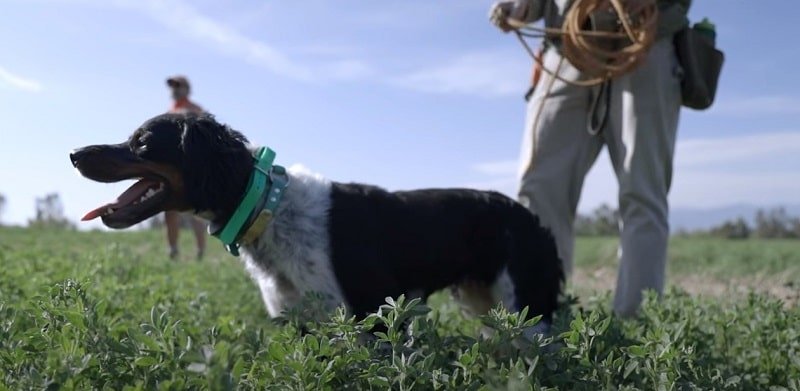
Many vets and dog behaviorists get this type of question regularly, with varying ages. If you’re new to this dog breed, you may expect your Brittany Spaniel to calm down when he is 12 months of age or whenever he reaches his full size – between 12 to 16 months.
A perfectly healthy Brittany Spaniel will reach physical maturity and meet all his physical milestones. However, mental maturity isn’t always guaranteed.
Brittany Spaniels are often hyperactive, playful, overly clingy, and struggle with social anxiety throughout their lives.
Many Britts seem to calm down only slightly with age, with some owners reporting a calmer dog by 10 or 11 months of age.
This doesn’t mean their dogs have mentally matured; it means that their dogs’ movements are more controlled and sophisticated. Your Brittany Spaniel won’t do so much romping but more deliberate jumping and running.
Knowing that this is a high-energy dog breed, as their owner, you must match their energy. An owner of such a vibrant dog must love the outdoors and enjoy running, jogging, hiking, and walking.
Exercise is essential, but discipline in the home is equally important. If you fail to gently and lovingly discipline your dog, he won’t listen to you in the long term.
He will be unpleasant, displaying unwanted behavior like barking, digging, chewing, jumping on people, etc.
If your Brittany Spaniel badly behaves at home, you need to start nipping it in the bud now. Please don’t be harsh with him; there is no need to shout or call him names.
When you catch your dog doing something wrong, say no firmly, clap your hands loudly to get his attention. If you usually give him treats, no more, he needs to know that treats are to be earned.
Final Thoughts
The Brittany Spaniel temperament is very like that of a hunting dog. This breed is intelligent, loving, playful, curious, loyal, and generally everything you would expect of a hunting dog. However, be aware that you will be kept busy.
Do not get a Brittany Spaniel expecting it to calm down at a certain age; they are biologically predisposed to being high-energy.
However, be intentional about bringing calm into your dogs’ life. Create a harmonious environment in your home, and make sure that you are providing sufficient exercise opportunities.
If you take the necessary steps to raise a balanced, polite, well-adjusted Brittany Spaniel, you will have a best friend who is excellent company outdoors and in your home.
Table Of Content
from Pet Dog FAQ https://www.petdogfaq.com/what-age-do-brittany-spaniels-calm-down/
Black and brown Labs are melanistic colors. Their genes are on the brown locus. However, yellow Labradors rely on alleles found in the Extension locus, the purpose of which is to dampen black and brown genes.
Breeding a chocolate labrador with a yellow labrador can be complicated with unexpected results. There are six possibilities for offspring color combinations, and much depends on the parents’ genotype.
As mentioned above, there are six different possibilities for litter color combinations:
Labrador genetics is complicated, and people are often surprised by the color of the litter they have bred. Coat colors, like diseases, can remain unknown from one generation to the next.
Even for numerous generations if they carry the recessive gene. Let’s explore the different color possibilities based on the parents’ genotypes and discuss how to mate a chocolate Lab with a yellow Lab.
What is the reason for these six combinations? Have a closer look at the diagram to discover why? The yellow Lab possible genotypes are on the top and the brown genotypes down the left-hand side. Inside the diagram are the possible litter color combinations.
EEBB EEBBEEBB
EEBB Yellow Yellow Yellow
Black Choc Choc
lack Choc Cho
Black
EEBB Black Black Choc
Choc
There are three ways to be a yellow Lab and just two ways to be a chocolate Lab, as shown in the diagram. A chocolate Lab can either be Eebb or EEbb.
A yellow Labrador can be any one of three possible genotypes – eeBB, eeBb, eebb. Anytime two lowercase ee’s come together, they cancel out the three different possible color combinations of bee genes.
Upon studying all the possible combinations, you will see possibilities for all three colors in a litter from eeBb mated with Eebb.
If EEbb breeds with eeBB, all the puppies will be black because they have the dominant big B and one big E.
‘eee’ genes are powerful. These genes provide the genetic information that creates a yellow coat, and they can cancel out or influence the ‘bee’ genes that make black and chocolate. Each dog will inherit two ‘eee’ genes, one from each parent, and two kinds of ‘eee’ genes.
The big E (dominant gene doesn’t interfere with the ‘bee’ gene.
The little e (recessive gene) can mask or cancel out the ‘bee’ gene that could otherwise produce black or brown coats, and the result is a yellow dog.
How To Mate A Chocolate Lab With A Yellow Lab
When considering pairing a chocolate Lab with a yellow Lab, your primary concern must not be the color of the litter; you should aim to breed puppies for health and longevity.
The motto of a responsible dog breeder is “Breed to improve.” Responsible breeding means being able to evaluate the positive and negative points of your dogs before deciding to mate them. The ultimate goal of breeding is always to produce better quality pets.
Understand the commitment to raising a litter. In the first few weeks, the dam mostly takes care of her puppies’ needs, but things can go wrong, like a dam producing no milk, or one of the puppies gets sick, and so on.
In such cases, you must step up and support the dam and the puppies and provide for their needs. It’s a lot of work! If you know you can put the work in, and you have a chocolate female that you want to mate with a yellow male or vice versa, please consider the following steps:

Step 1 Select An Appropriate Mate
When deciding on a mating pair, you must first consider the sire and dam are registered with the AKC. If they are, you can register the offspring with the AKC.
When choosing a male for your dam, it’s essential to mate dogs that match well together. Choose a male Lab that will strengthen your females’ weaknesses and enhance her best qualities.
So, if your dam has a dull coat, find a mate with a good coat, ensuring that he comes from a dog line with good coats.
It’s crucial to seek the wisdom of other breeders, who can help you consider all the factors that determine your dog’s appearances and traits.
Two vital considerations when making your selection are health and temperament.
When it comes to health, Labs are subject to many hereditary illnesses. Some can be life restricting or, worse, fatal. The primary breeding goal is to produce offspring not affected by known genetic diseases prevalent in your breed.
Step 2 Know Your Genetics
A responsible breeder must have a decent grasp of genetics. Genetics will determine your future litters’ health, looks, temperament, and soundness.
Finding a mating pair, the appearance of the dogs must not be the only deciding factor. Instead, you must base your choice on understanding the animals’ genes and how they are inherited and expressed.
A dominant arrangement of inherited diseases requires just one anomalistic gene. It takes only one parent to be affected for the condition to manifest in successive generations.
Some conditions can be difficult to detect if the effects are mild and seem to skip generations.
A recessive arrangement of inherited diseases occurs when dogs possess two abnormal genes. A Lab with one normal and one mutant gene can be carriers. They can appear normal but pass the mutant gene to their puppies.
Defects in the chromosome structure and number can result in genetic diseases, producing severe defects. Dogs usually have 39 chromosomal pairs where genes are located.
Polygenic disorders arise from the collective function of many different genes. The precise number of genes and their unique functions are indeterminable.
Inheritable patterns can vary from one generation to the next. Polygenic inheritance often copies either recessive or dominant inheritance, leading to false conclusions about underlying genetic anomalies.
Step 3 – Finalize Stud Contract
When you have completed the essential health checks and selected a suitable mate for your dam, you must draw up a contract with the stud’s owner before breeding occurs.
The contractual agreement must be typed and printed; it should stipulate obligations and circumstances. Both parties should sign the contract, and each receives a copy.
The studs’ owner sets the fee and the type of payment. The male dogs’ owner might request a stud fee or a selection of one or more of the puppies.
The contract must state that the sire’s owner isn’t duty-bound to sign the AKC registration application before receiving the stud fee payment. The AKC cannot settle any disputes between the parties regarding contractual agreements and breeding arrangements.
Step 4 – Health Checks Before Breeding
If you expect good quality puppies, the parents should receive ongoing maintenance. Regular Veterinary care, genetic screening, pre-breeding tests, quality nutrition, and exercise are essential to produce healthy litters.
The female’s mental health needs attention as a well-adjusted female is likely to be a better mother than one with a hostile temperament.
The female will need a pre-breeding physical exam by a veterinarian about one month before breeding. Vaccinations must be up-to-date, and her vet must examine her for parasites and offer treatment if necessary.
Both the male and female should be checked for brucellosis, an infectious bacterial condition causing possible sterility and miscarriage in affected dogs.
Step 5 – Natural Breeding
An ethical breeder will not breed a female in her first heat to prevent imposing the pregnancy stresses on a young, still developing animal. It would be best if you also permitted enough time for recovery between pregnancies, so avoid breeding a female on consecutive heats.
Most dogs mate within the tenth and fourteenth day of the females’ reproductive cycle – if the female accepts her partner, mating every second day for a total of two to three matings is sufficient.
Natural breeding happens when the sire mounts the dam from behind. When pelvic thrusts cease, both dogs won’t part for up to half an hour; this is called a tie, during which a male might move until he is rear to rear with the female.
It would be best if you refrained from separating them during the tie as it can cause injury to one or both of the animals. Eventually, they will separate by themselves.
Step 6 – Artificial Insemination
When natural breeding proves to be problematic, artificial insemination is an alternative solution, and it is a straightforward procedure.
The AKC accepts the resulting offspring if insemination involved using fresh semen, frozen semen, and fresh extended semen, and as long as correct procedures are in place.
Final Thoughts
The science of Labrador genetics is undoubtedly a fascinating subject. As we can see with the chocolate and yellow Labrador, they can produce offspring of any of the six color combinations when paired.
However, a breeder’s primary focus is to improve the quality of their dogs and seek to produce healthy, well-adjusted puppies for future generations.
Make sure to provide a warm, dry, and calm whelping environment for your female when the time comes for her to birth her puppies.
from Pet Dog FAQ https://www.petdogfaq.com/breed-a-chocolate-and-yellow-lab/
Labradors are immensely popular as pets due to their intelligence, gentle nature, and trainability – they are also very patient with children. Everyone can agree that all Labradors are adorable puppies. In recent years, brown Labs have increased in demand, with more people favoring puppies with chocolate coats.
Generally speaking, chocolate labradors are born entirely brown, varying slightly from light to dark. Their coats often lighten with age as their fur grows longer. Occasionally, brown puppies are born with tan markings over their eyes, chest, feet, and under their tail.
The AKC cannot show chocolate-colored dogs featuring these markings in conformation classes. For these canines to be considered real chocolate labs, their nose, paws, pads, and eyes must be the same color as their coat. However, some fading on the nose is permitted.
It is worth noting that chocolate Labradors share most of the same physical and size traits as their black and yellow siblings; the only significant difference is their hue. This article will explore the history of the chocolate Labrador, Labrador genetics, and other heritable issues associated with their color.
Labradors originated in Newfoundland and were initially known as the St. John’s dog and Newfoundland dog. It’s believed that the Labrador Retriever came from crossing a French St. Hubert’s dog and a Greater Newfoundland dog.
When English fishermen migrated to Newfoundland, Canada, in the 1500s, they used Retriever dogs to help them catch fish and retrieve nets.
These dogs thrived on hard work, even working long hours, swimming in freezing waters. After a long day of hard toil, these dogs returned to the fishermen’s homes and played with their children, proving to be excellent pets as well as working companions.
The retriever was first noticed by the English gentry visiting Canada in the early 19th century. These noblemen returned to England with excellent specimens of the breed.
In 1807 a ship (called the Canton) intended for Poole, England, was transporting some St. John’s dogs for the Duke of Malmesbury as part of his breeding stock.
The Canton shipwrecked; however, two dogs, one black and one brown were discovered and believed to produce the Chesapeake Retriever. The recessive colors of chocolate and gold/yellow appeared in the early litters occasionally.
These recessive dogs were unwanted and considered as ‘off colors’; they were often culled. English breeders standardized the Labrador during the second half of the 19th century to include brown and yellow dogs. The AKC in the USA recognized the Labrador breed in 1917.
The popularity of the chocolate Labrador began to increase slightly in the 1920s and 1930s, as that color was considered fashionable.
The 1960s saw high demand for chocolate Labradors. In recent years, the appeal of the brown-coated Lab has declined due to some of the negative hereditary traits connected to the coat color.
Genetics determines Labrador coat color; if you wish to breed chocolate Lab puppies, you must test the potential parents for genetically heritable colors.
Crossbreeding two chocolate Labradors results in an average of 73% brown offspring and 27% yellow/gold puppies.
A chocolate Labrador can still carry the genetic code for other colors. However, a reputable dog breeder will understand how genetics functions to select certain colors and prevent hereditary illnesses.
For a complete picture of how genetics works, a gene contains two alleles, one per parent that, when paired, creates a genotype, distinguishing a phenotype. In other words, genetic coding in the genotype manifests specific physical or behavioral characteristics.
Alleles are designated by a capital letter (for the dominant gene) and a lowercase letter (for the recessive gene). Tw0 dominant alleles create dominant traits, as is the case with black Labradors.
When a dominant allele is coupled with a recessive allele, the dominant trait can override the recessive or produce a mixed trait with its phenotype. Chocolate Labradors are an example of this.
Both chocolate and black Labs derive their color from a pigment called eumelanin. Labradors with high levels of eumelanin pigment have black coats.
If they have a little less, they will have brown coats. The B locus in a canine’s DNA produces the genetic instruction for black or brown coats.
The B locus is central to a pair of genes called B genes. One of the pair comes from the dam, the other from the sire. Capital B is a dominant gene, and lowercase b is a recessive gene.
The dominant black gene will always cancel out the brown gene. Only Labs with a matching pair of the b gene will look brown.
* BB produces a black Lab because he has two genes for a black coat.
* Bb creates a black Lab because the dominant B gene overrides the recessive b gene.
* bb produces brown Labradors and will provide the instruction for less eumelanin in the coat.
Chocolate Labradors have remained steadily popular throughout recent years. Nevertheless, the dominant black color means that the demand for chocolate labs remains limited, ensuring continued rarity within the breed.
Continual breeding of black dogs will only produce black offspring. If dogs with a Bb gene only mate with dogs with a BB gene, the b gene will carry on to future generations, never to be expressed.
Brown is a recessive trait, so both parents must carry it to produce brown offspring. Breeding litter from this shallow gene pool comes with some health risks.
While the gene for a chocolate coat is not bad for a dog’s well-being, issues arise when dogs are bred for color, not health.
Chocolate Labs usually keep the same brown shade their entire lives. Seasonal changes can bring about slight changes to your Labs coat.
Dogs experience molt to make way for new fur growth. After a blowout, the lighter undercoat will become exposed, combined with sun bleaching, it can produce what seems like a fairer coat.
You may notice your chocolate Labrador develop a fuller, thicker coat in the cold weather, which could make the coat appear darker.
Brown-colored Labrador Retrievers have on average about 10% shorter lifespans than their black or yellow counterparts. They are also more likely to get ear infections and skin diseases than the other-colored Labs.
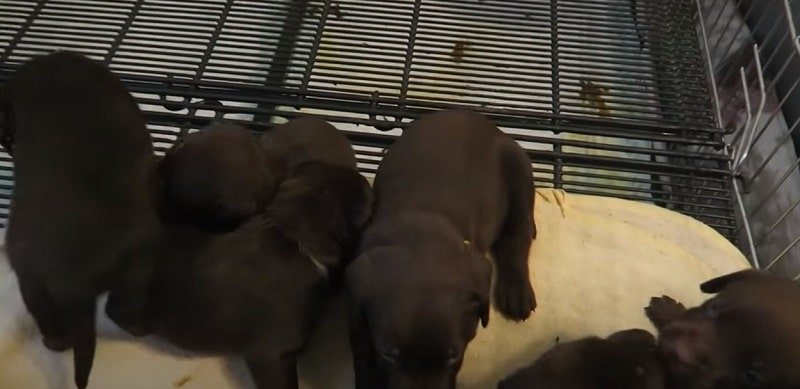
Aside from health, behavior is connected to coat color too. While it’s unclear that coat color is entirely to blame for certain behavioral traits.
Brown Labs contain different retinas to their black and yellow siblings. Retinal differences can contribute to some behavioral characteristics as observed in sighthounds like whippets and Grayhounds.
Even if the coat color doesn’t affect Labrador behavior, there is evidence to suggest it may affect how humans behave with them.
One study revealed that people who look at pictures of black and yellow dogs rate the dogs higher in emotional stability and agreeableness than brown dogs.
Labradors are famous for their high intelligence. However, chocolate Labs are considered far less intelligent. This should not be the case; if you notice that chocolate Labradors are not as smart as their black and yellow counterparts, this is irresponsible breeding.
Many chocolate breeding’s throughout America are irresponsible breedings. These “backyard” breeders have invested time and effort in achieving the chocolate coat color with no regard for health, intelligence, or temperament.
Intelligent, good-natured chocolate Labradors exist, although far less common than the other colors. It’s essential to find a knowledgeable, reputable breeder that cares about producing calmer, intelligent, well-rounded Labradors.
This question is surprisingly popular, but yes, some chocolate Labradors are born with blue eyes; any dog breed can have virtually any eye color, much depends on genetics.
However, a Labrador with blue eyes indicates poor genetics. Labrador eye color should be brown in both black and yellow Labradors. Brown Labradors should have hazel or brown eyes.
Blue eyes on a chocolate Labrador is pretty, but it means unequivocally that this dog is not purebred.
When puppies are born, their eyes remain closed for 14 days, and at that stage, their eye color is blue until it changes to their permanent brown or hazel color.
When a chocolate Labrador is around the age of 4 to 4 weeks old, their eye color is more noticeable, and you should be able to predict their actual color.
What color are chocolate Labs at birth? We now know that they are born entirely brown, which remains consistent throughout their life. Some are born with markings on different body parts.
Unfortunately, these dogs were considered undesirable for a long time, but equally deliberate and irresponsible overbreeding of the chocolate Labrador has caused so many problems for the breed.
The future of the chocolate labrador seems to be improving steadily, with more reputable breeders choosing to produce Labradors for health, intelligence, and temperament rather than color. Chocolate Labradors are generally wonderful pets as they are friendly, confident, and playful.
Table Of Content
from Pet Dog FAQ https://www.petdogfaq.com/what-color-are-chocolate-labs-at-birth/
Do Shih Tzu suffer from separation anxiety? Shih Tzu can suffer from anxiety and there are three simple steps you can take to alleviate the problem. First make sure they get some exercise before you leave for work. Second don’t make a fuss before you leave, and finally give him a special toy to play with during the day.

https://vtscripts.s3.amazonaws.com/vt.js
To ensure your dog is happy when you leave him alone follow these top five tips to stop Separation anxiety.
Top Tip #1
You are guilty, I know I’m guilty I’ve done this before. When you’re leaving your house make a big deal out of something that doesn’t need to be a big deal. So when you leave there shouldn’t be any of that googoo gaga I love you, I miss you, you’re creeping out the door and then slam the door.
What happens is you’re marking to the dog and you’re basically telling the dog “hey I’m about to leave for a long period of time” and of course your dog hates that.
Your dog loves you, you love your dog, it’s a terrible thing but if you make that a process and you telling the dog “hey this is about to happen, you know, that thing that you really hate that I do every day Monday through Friday, I’m about to do it again”.
And if you’re marking that behavior and you’re telling the dog, it’s about to happen, that creates anxiety, the dog goes “oh boy this is the time that I don’t like”.
There could be positive anxiety too through positive things, like going for a walk, coming home, these things are positive so you’re adding something to the mix to make things are potentially better but you’re creating negative impact on the dog’s behavior and mental stimulation.
And so what happens is the dog gets overstimulated and they go “I don’t know what we’re gonna do” and gets over excited so what you don’t want to do is, you don’t want to talk to your dog before you leave.
It’s very simple, if you’ve already started to create anxiety and your dogs getting a little nervous when you are about to leave and he starts whining and pacing and barking ,just walk out, that’s the best thing to do.
I know it’s not that easy, you just want to say goodbye to fluffy one more time before you go to work, but you have to give the dog the benefit of the doubt and understand that that creates stress. They’re trying to figure out what the heck you’re saying and they know that you’re leaving, which sucks.
In conclusion, if you’re having these conversations before you leave and you’re making this big drawn-out process getting the dog basically amped up to leave the dog for four to six hours, it’s not a good idea. You’re gonna create stress and anxiety because the dog knows you’re about to leave and they can’t go with you.
If you have anxiety and you have stress in the dog already, one of the big things that you can do on your day off is you can go out with your dog. Taking your dog out can help to desensitize this whole process of you leaving for four to six hours, because that’s actually why the stress is there.
It’s because when you leave they know you’re gonna be gone for that big extended period of time and they don’t like that. So going out and coming back in and going out and coming back in and going out and coming back in, this helps them get used to you being there for shorter periods.
Change out the duration, go out for two minutes, go out for 30 seconds come back in, the mental state of the dog will be like “oh so you’re not leaving for four hours like you normally do” and you break it down and then that way when you’re ready to actually go to work on Monday, you just walk out.
The dogs gonna go “huh, okay, I’ll wait for you to get back like you normally do” and so breaking down that whole process through increments on your days off, or just waking up a little bit earlier before you go to work to break down that process.
Okay now this is a big one. For all across the board for all sorts of behaviors exercise is dogs they have four legs, we have two. they like to eat cat poop and roll around and dead mice we don’t. They’re animals, we have to remember that what we’re dealing with and what we’re living with at home has to go out and get mental and physical exercise and outlets.
So if this means waking up a little bit earlier before you go to work, so be it. But you have to understand that if you’re not exercising your dog properly or even at all, it’s gonna be even harder for your dog as they’re sitting home just waiting for you to come back.
It’s gonna make that stress and anxiety even more because they have so much built-up and they can’t let it out on anything. I know how it is guys, you come home, you want to crack a beer and sit in the couch or drink tea or whatever you do the last thing. The last thing you want to do after a long day is go for a really long walk, especially if you live in climates that’s super cold or super hot.
I get it, but we have to remember that we can’t complain about the stress and anxiety we create due to the lack of due diligence of us actually exercising the animal we have at home.
Number two on a recap is just exercise, wake up a little bit earlier, throw a ball but also one thing that you probably haven’t been thinking about is mental stimulation.
Mental exercise
Doing something with your dog, even if it’s basic obedience sit down, stay, heel whatever it is you can do to get the dog’s mind unwound a little bit.
Dogs can run 4 depending on the breed 5 to 10 miles straight. Some dogs can’t do a mile but you have to understand that dogs are so active and so primitive and so primal that they can run for a long period of time, and it’s not gonna bother them like it bothers us.
Number Three
Last but not least on this list for the top three things I would suggest to eliminate anxiety is getting them something to do while you’re gone.
Give you guys one thing to walk away with it would be to type in Google “dog walker in my area”. Look them up, look at their ratings, look at the reviews, see what you like, what you don’t like, look at the pricing etc.
It’s super easy, you can get somebody to do it for like 20 bucks, 30 bucks on the higher end, depending on where you live and they’ll come as many times as you want throughout the day Monday through Friday, sometimes weekends to let your dog out while your work.
I know it’s financially a burden, it could be but you gotta understand that we invited our dogs into our houses, they didn’t let themselves in and say “hey can I live with you”, it’s something that we have to take responsibility for.
It’s super important because you’ll create stress and anxiety especially in younger active dogs who are just sitting around doing nothing, which leads me to my second tip on rule number three or tip number three leads me to daycare.
Same strategies as what we’re talking about with the dog walker. Go on Google, find doggy daycare near me and look at their reviews. Go in there and do a consultation, see what you like, what you don’t like just make sure that there’s people in the back making sure that they’re with the dogs, that’s important.
Do your research on that and you’ll find the right fit for you and your dog. You can spend twenty to thirty dollars a day for your dog to go and run around with a bunch of dog friends which is fantastic versus sitting home doing nothing.
So those things will really really help your dog exert that mental and physical exercise that they so desperately need to do.
The other easy thing you can do when you’re gone, if you haven’t already, is give them something to chew on like a Kong. I use marrow bones stuffed with peanut butter and freeze them, you can find things like bully sticks, you can do all sorts of different stuff to really make sure that your dog is ok when you’re gone.
The other thing that you can do while you’re gone is leave something on to cut the white noise out, so leaving a radio on or the TV on to cut that white noise is also really important as well .
To recap guys number one don’t make a big deal when you leave the house, if it doesn’t have to be. Number two exercise is so important so give your dog mental and physical exercise before and after you come home from work. It’ll release and decompress all that built-up stress and anxiety that sits there while you’re out at work.
Number three. Give them something to do so hiring a dog walker, getting a daycare, coming home from work on a lunch break to walk them around. A big backyard is better than sitting at home but it’s still not enough giving them something to do like Kong or frozen bone.
Leaving the radio on, leaving the TV on, having your neighbor pop over giving them something to do while you’re at work.
I’ve gotten a huge number of requests on facebook and through email asking to do an article on separation anxiety, so here we go.
So right away I want to say that a short article here is woefully inadequate to cover everything to do with separation anxiety. There are so many factors and moving parts to it, and every single case is unique.
This article is not going to give you quick fixes, I will, however, help you better understand the issue and point you in the right direction to find good resources.
Let’s start off by clearing up the terminology. The term “separation anxiety” has been bandied about so much that it’s lost a lot of its meaning.
Everybody thinks that when they’re dog chews up a shoe while they’re gone, or pees on the rug, or looks sad when they leave, or acts silly when they come home they must have separation anxiety.
Generally this is not the case. In fact some of these are just simple training issues that haven’t been resolved through practice and consistency. In other cases it’s more accurate to call it distress, and there is a difference.
Also we need to see if it’s a case of separation or just isolation; there’s a difference there too. So let’s look at these.
Separation problems stem from a dog’s attachment to one person or a group of people. In these instances, no other person or animal can alleviate the stress. The only thing presently that will help is the return of the specific person or persons.
Isolation problems are more about not wanting to be alone. Dogs are extremely social animals, that is to say they seek out company and companionship and they form close social groups. In these cases another person or even another animal can help alleviate the problem.
Each of these types of stressors— separation and isolation—then exist on a sliding scale with distress being at the low end and true anxiety being at the high end. True separation or isolation anxiety is serious stuff.
These are the dogs that bloody themselves escaping from crates, that jump out of third story windows, and have worked themselves into frothy states of wide-eyed panic.
These are clinical cases that require professional intervention. Distress is what most of you out there are experiencing, not anxiety. Whining or barking when you leave is not anxiety.
Chewing up tissues and pillows while you’re gone is not anxiety. At best they’re symptoms of boredom and at worst they’re symptoms of distress, which is easily addressed in many cases.

So for example a dog with mild isolation distress will get itchy about being alone and get bored and then start doing things to occupy himself like chewing or barking.
In these cases sometimes just giving them things to do that they enjoy will help. Sometimes they just need company—another person or even another pet. Here’s where a pet sitter or dog walker in the middle of the day might help.
In order to start helping your dog you’ll need to determine whether your dog has a problem with separation or isolation, and then objectively measure how severe things are.
Don’t buy into the notion that it’s automatically anxiety or even that it’s automatically separation. Our egos would love us to believe it’s always about us but realistically it might not be.
It’s useful to make these distinctions because it changes how you may approach the situation. Separation problems are generally harder to fix than isolation problems, depending on how severe things are.
We all do a disservice when we just start labeling everything “separation anxiety” when there are dogs out there that truly needs serious help and we lump them in with dogs that just need a chew toy and some training.
This whole problem gets even more complicated when dogs have pent up energy throughout the day without reasonable outlets. It also becomes more pronounced when dogs are never taught how to be alone.
Now there are gadgets and bits of gear out there that are designed to keep your dog busy throughout the day. Things like D.A.P. and relaxing flower essences, thundershirts, music and tone therapy, and interactive toys like the Manners Minder, Wobbler, and even just basic Kong toys.
But please understand that these are not the solutions; they’re only part of the solution. And they’re not plug-and-play kinds of things, or set it and forget it. You must train your dog how to interact with them and train your dog to love them.
Yes even Thundershirts. As I’ve said many times before it’s not what it is it’s what you’ve trained it to be. If you just buy something and leave it with them the chances it will change anything are almost zero.
Which brings me to an important point: there are no cookie cutters for anxiety or distress. There are no magic bullets. There are no 123 fixes you might have found on a separation anxiety board and Pinterest that are going to do the job.
Think about people you know—maybe yourself—that suffer from anxiety. There isn’t just a thing you buy or a pin you read that fixes it, is there?
Well for starters like almost every other problem out there it’s predictable and preventable. So if you’re reading this and you have a new puppy or even a newly adopted adolescent dog, teach them how to be alone for periods of time.
A dog needs to be content with spending time alone. If you’ve watched my toy training article or my Kong article you know that one of the main points is training chew toys to be outlets for exactly the kind of stress being alone creates.
Do your homework and get the best you can reasonably afford. A crappy diet will most definitely exacerbate anxiety and distress problems just like a does in humans.
Get your dog some exercise and some mental stimulation. Activities like flyball, rally, agility, nosework, and K9 games are ones that not only get the blood moving but help the brain grow.
Manage your dog’s space. Use gates to limit access to parts of the house you don’t want them in.

Crate train them. These are just the tip of the iceberg. To help you wrap your head around this process there are a couple of really good books on the subject I recommend.
The first one is I’ll Be Home Soon: How to Prevent and Treat Separation Anxiety by Patricia B. McConnell, PhD. She’s a stalwart figure in the behavior community and her work forms the basis for most of it out there.
The second book is Don’t Leave Me: Step-by-Step Help for Your Dog’s Separation Anxiety by Nicole Wilde, CPDT-KA.
Nicole is a nationally recognized consultant; her books and articles are always gold very—easy to read and accessible for everyone.
Pick one or both of these up and see if they can give you the guidance you need to solve your problem. At the very least they’ll help you build a foundation to work with while you seek additional help.
And you probably should seek additional help. Some anxiety or distress issues stem from genetics or past experiences which we have no control over. My best piece of advice is to hire a behaviorist. A behaviorist is different than a trainer.
Your local dog trainer will usually not have the experience or knowledge to adequately address anything more than simple distress.
A good behaviorist will help you design a plan that fits your dog and your lifestyle. A behaviorist will know how to problem-solve and offer multiple solutions.
These can include plans for management, nutrition, exercise, mental stimulation, and training.
In a robust approach these will all be supported by adjudicative strategies like drug therapy, desensitization, and conditioning. And your behaviorist will help you train those gadgets and gear we mentioned earlier so they actually work for you.
To find a qualified behaviorist, start with a search on the APDT’s website. the APDT, or the Association of Professional Dog Trainers has a registry that you can search through.
Most professional organizations such as the American Veterinary Society of Animal Behavior, the Certification Council for Professional Dog Trainers, and the Association of Animal Behavior Professionals also have similar registries.
Membership in one or more professional organization is a good start. It indicates standards met, communication with colleagues, and a means to keep current on new info. But it’s not a guarantee of quality.
Once you find a person, ask about their professional training and their experience. Always ask about their experience level. A seasoned practitioner with no professional credentials is preferable to someone with credentials but with limited or no experience.
Also contact the local shelters and rescues for their recommendations. These organizations see a thousand times the amount of dogs you’ve ever even owned and they have a roster of professionals that they rely on.
Look for someone who recognizes the importance of you working through the problem rather than sending the dog somewhere to get “fixed.”
Anxiety and distress are completely inappropriate for any kind of board and train services. Work needs to be done at home.
Look for knowledge of positive reinforcement methods, classical conditioning, progressive desensitization, and making food, toys, and play integral parts of building good behavior.
This is a must. Any kind of adversive techniques that are painful, scary, or stern will be absolutely counterproductive.
Now, there are trainers out there that have experience with behavior consulting and vice versa. You may find that rare someone who is versed in both training and behavioral methodology.
Please do not ask your vet for behavior advice unless you are inquiring about drug therapy suggested by your behaviorist.
Vets are not trained in behavior. They are trained in anatomy, procedures, diagnosis, treatment, and medicine. They will be the medicinal and drug expert, but your behaviorist will know better what to do in conjunction with it.
Look: I respect the veterinary community greatly and I always learned tons from them. But I have seen vets prescribe drugs to dogs that didn’t need it, and I’ve seen dogs put through ridiculous exercises when they needed drugs and management.
I know it is tempting to ask the pet professionals in your life for help but seek the best sources. You don’t ask your plumber for electrical advice, right? Also do not ask or take advice from pet store employees.
These people are there to tell you what’s on sale. That’s like asking someone who works at Rite Aid to give you medical advice.
Always seek advice from the best sources. If you need training advice you call a trainer. If your pet is hurt or sick call your vet. If you have a grooming question call your groomer. If your dog’s diet needs tweaking contact a nutritionist. And if you have behavior problems call a behaviorist.
Well good luck to you if you’re struggling, whether it be easily solved isolation distress or you’re in for the long haul with real separation anxiety. Don’t be afraid to ask for help and make sure to explore the resources around you.

Shih Tzu’s can get constipated, but don’t worry there are natural remedies that can help.
What to do if my Shih Tzu is constipated? There are a number of remedies you can use to relieve constipation fast for your Shih Tzu, including tinned pumpkins, Coconut oil and flax-seeds. If those natural remedies don’t work then you can try an enema.
Before we go into what you can do to help your Shih Tzu with their constipation let’s look at what actually causes might be.
Constipation is caused by too much or too little fiber in their diet, a lack of exercise, blocked or abscessed anal glands, an enlarged prostate gland, excessive matted hair around the anus or obesity.
If your dog eats gravel, stones, bones, dirt, plants or pieces of their toys that can also cause constipation. Whatever can get caught in their intestinal tract will also affect their digestive tract.
There are some rare things like tumors but that’s very rare and you shouldn’t normally have to worry about that, unless there’s an obvious growth.
If your pet is on any type of medication, if they have an injury to the pelvis or it could even just be part of your pets neurological disorder.
They could even be dehydrated, so you can see there are a myriad of reasons why your dog can be constipated.
If your dog has not had a bowel movement in over two days or if he’s obviously straining, crouching or even if he Yelp’s in pain when trying to go poop you should see your vet right away.
These signs may be similar to those seen in a urinary tract problem, so it’s important that you see your vet to determine the cause.
Older dogs may suffer more often from constipation, however, the condition can occur in any dog that has one or more of those reasons I have listed.
Now, depending on what caused your dog’s constipation your vet may recommend one or several of the following treatments.
Your vet might put your dog on a special high fiber food, they might ask you to exercise more or they may even give your dog an enema.
If your dog is badly constipated you can try an enema which is something that you can use at home, again you want to be real gentle with it.
Sometimes it’s better to let your veterinarian do this because the dogs already in a little bit of distress and if you try and give an enema they could bite you.
They are probably in pain so you have to use your head. As the Shih Tzu is a small toy dog you might only need to use a quarter of the enema, just squirt it up into the rectal area and then soon after that all the stool will come back out again. Again if you are not comfortable doing it yourself let your vet do it for you.
Again you want to be real gentle with it, sometimes it’s better to let your veterinarian do this because the dogs already in a little bit of distress and if you try and give an enema they could hurt you and try and bite you.
If you don’t treat the constipation your dog’s colon can empty on its own. I this state because the colon is packed with an uncomfortably large amount of feces and that’ll cause really damaging straining.
Your pet will be very tired, he’ll have appetite loss, he might even start vomiting because his digestive system is just too full.
You have to be sure it’s an accurate diagnosis, you don’t want to be giving an enema to a dog that has straining for some other reason, but if your dog has been having problems with constipation I think its first important to change their diet.
Is your Shih Tzu having difficulties going to the bathroom? In this section I’m going to give you my top three natural laxatives for your dog.
I have three things for you and the first one is ground flaxseed. It’s a great source of fiber, also a really good source of essential fatty acids. Additionally it has about four times the equivalent amount of fiber than you would find in oatmeal.
I prefer to use ground seeds and and a dosage of about a tablespoon for forty pounds of body weight, so a little over a teaspoon for about ten pounds of body weight and would give it to my dog twice daily.
The next one that is often quite prevalent during Halloween which is also a super good source of fiber and is a great natural laxative and that is canned pumpkin. Pumpkin is a great natural laxative for dogs and the really good things is its nutritious.
The dosage is about a teaspoon for 10 pounds of body weight again about twice per day. If you have problems getting your dog to eat the flax seed or pumpkin add it too their food or what l like to do, especially with the pumpkin is put it on top of their paw and they just lick it off.
The third remedy I use is coconut oil. The thing with the coconut oil is not all of it is gonna get absorbed, and historically that’s some of the issues with some of the other oils.
You give your dog the oil in their food, it gets absorbed into your dog’s stomach and into the small intestine.
It can act as a relaxing agent but we need part of it to make its way through and actually help loosen things up and help move things out and this can also do that.
You need to make sure you don’t overdose it as it can cause diarrhea so a pretty typical dose is somewhere around a half a teaspoon to 1 teaspoon per 10 pounds of body weight 2 to 3 times a day.
If your dog is seriously constipated and you want to get stuff moving I’d be upping the dose to 3 times a day.
If your dog is older and he has some kind of a medical problem where he’s coming in constipated a lot, you could add some Metamucil to their diet.
You can do that by putting the food in a blender and adding a Metamucil for dogs to it, mixing it up and having the dog enjoy that as a nice meal.
The thing with Metamucil is you can use it all the time to try and keep the stools normal.
So start with small amounts first of the Metamucil if you overdo it you could turn up a dog that’s constipated into a dog with diarrhea.

Just recently my Shih Tzu started crying all the time, to be honest it was getting on my nerves so I decided to look at the reasons why and this is what I found.
Why does my shih tzu cry all the time? There are a number of reason your Shih Tzu cries or whines all the time which can include physical needs like they need to potty or hungry or is anxious about something. In this article we look into all the reasons your Shin Tzu might whine and how to stop them.
After reading some of the dog forums a lot of people seem to be having problems with their Shih Tzu whining and crying all the time. Whining or crying is a different way for your dog to communicate and in this article we are going to go through the different types of crying and how to stop them.
Interpreting a dogs crying can be really tough and there are lots of different reasons for it. As with barking whining and crying is a different way for your dog to communicate. Often when they cry they are trying to tell us they want something, it can be food, a toy or just some attention.
Often whining and crying will turn into a problem behavior because when your dogs learn that when they do cry they will often get the attention they want. However, there are obviously more serious problems when dogs cry. It could be to do with pain, anxiety or age related decline.
This is why we always recommend you take your dog to the vet if you notice your dog whimpering or crying more than normal. I am going to run through the different categories of whining in dogs.
If your dog starts to whimper very suddenly it’s usually for a physical need. This could be food, water, to go outside to potty, for a toy or just for attention.
Category two is appeasement and this is usually combined with submissive posture from your dog, this is when your dog has their ears, tail and head down. In a pack a dog would tell another dominant dog that they give up by submissive whining.
A dog may whine when creeting you as a form of excitement. You will be able to spot this quite easily because it is normally accompanied by jumping, wagging their tail or spinning around.
Anxiety is a strong reflex in dogs and there are multiple types of anxiety. Storm anxiety, separation anxiety which is probably one of the worst we see and sometimes some of the hardest ones to control.
The symptoms are generally going to be destructive in a lot of dogs. They will tear up things when owners are away, tear up their crate or cage, they can tear up their toys excessively, you can also see other symptoms like urinating or defecating when the owners were gone or when a storm is coming.
There are multiple different symptoms that can be going on and this creates a lot of problems for the owners and a lot of problems for the dogs as well. Anxiety can also cause diarrhea and vomiting and causing so much stress that the GI system reacts negatively.
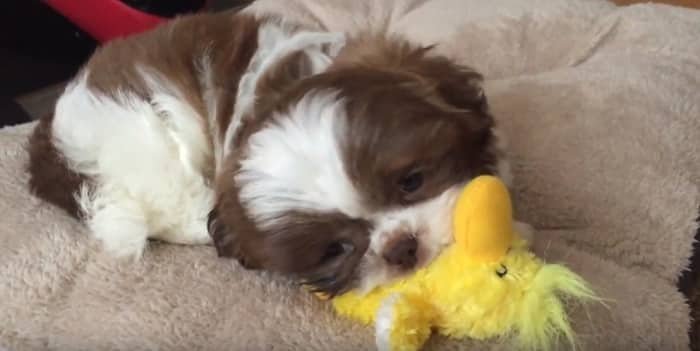
Anxiety in dogs can be very serious so if your dog has some sort of anxiety disorder like storm phobias, loud noise phobias or especially separation anxiety you should talk to your veterinary clinic.
An anxious dog may whine while pacing up and down and showing unsertan body language like their tail being down and their ears being down.
Now we know what causes our dog to whine and cry, let’s look at some ways of stopping it based on the categories we have just run through. The way we suggest to build their confidence is to treat them with reward led obedience training.
Both of these categories are dealt with in a very similar way because they are both to do with a lack of confidence in your dog.
One on one reward based training will allow you to reward them for confident and focused behavior. It’s important to ignore any bad behavior, do not approach this with verbal or physical punishment.
As I said before, it’s very difficult to differentiate between what your dog needs when they are attention whining. To stop this type of crying you need to learn to ignore it, so when your dog stops whining that’s when you take them out, that’s when you give them food, that’s when you give them attention.
Don’t do it while they are whining because they will associate crying with getting what they want. So your main aim for this is for your dog to know that when they stop crying when they get your attention. If he gets it before he is going to associate the whining to get what he wanted.
This can seem really cute when you see your dog crying when you come through the door but if it is becoming a problem behavior you really need to address it. So when you come it try and greet them with a calmer tone and your dog will them greet you with a mirror tone and action.
If your dog has suddenly started whining then you should get them checked out by your vet. There will be a reason for the sudden crying or whining and it could be a number of things for your dogs health and welfare get them checked out as soon as possible.
If your dog keeps you up at night it can be really overwhelming to deal with but what do you do when your dog cries at night? Should to take your dog out every time they cry? Do you ignore them? Let them cry it out? Scold them or what?
First let’s examine why your puppy might cry at night. The thing is dogs don’t intuitively understand our daily schedules and if you have a new dog there is a really good chance they have been thrown off by their new circumstances and surroundings.
This can cause anxiety which can cause many dogs to feel uneasy and cry or whine. This adjustment period is the single biggest reason that dogs cry at night.
When babies cry we ask “have all their needs been met?” and then we act accordingly. This is basically what we should do with our dogs too. Remember, if you have a new Shih Tzu puppy you’re actually not entitled to sleep all the way through the night. I mean, you should be taking them outside to potty a couple of times per night.

Once your dog is about three to four months old they ought to be able to physically make it all the way through the entire night without needing to pee.
Over time you will learn the difference between all of your dogs different whines and cries. One of them might mean “Hey I need to be taken outside right now” while another one could mean “I am hungry so feed me”. And then there is the classic “I am so bored I’m going to whine”.
The boredom whine is actually pretty common, it’s pretty easy to overcome in most cases. For immediate relief give then age appropriate mental exercise through the day. And make sure you give them exercise just before putting them to bed.
During the day discourage excessive napping, for most dogs a thirty minute walk should do the trick. A good way to exercise your Shih Tzu is to play fetch using one of their favorite toys. The good thing about throwing a toy for your dog is that you can do this in your back garden or yard, or even inside your home.
Working on obedience and mental training is also a good way to train your dog and this can help them sleep through the night too. You know the feeling when you have been studying all day for an exam, that’s the feeling we are going for with your dog.

When you put them to bed consider giving them a chew toy so they have something to do so they are less likely to be bored.
If you have ruled out any medical issues by asking your vet, make sure your dog has lots of healthy physical and mental exercise. If you have taken care of all their needs like food, water and going outside and they are still crying, it’s probably time to just ignore the crying for a while.
When your dog is whining or barking a minute can feel like ten minutes so why not time how long it actually takes your dog to calm down. Keeping track of the time can help you notice progress where you otherwise might not.
Once your dog is quiet after five, ten or fifteen minutes take note of than time. Your goal is to see if the time your dog cries get shorter and shorter over time.
It’s not like this type of behavior goes away all at once so this can help you notice progress where you otherwise might not.
Of course, if your dog seems extremely stressed out this could mean they don’t like their dog crate or they don’t like being away from you in another room. This is why we would encourage you to use a dog crate to get your dog used to being away from you. We have a great article which explains how to crate train your Shih Tzu in five easy to follow steps.
Depending on what age your puppy is there’s many different things you can do to help soothe them, calm them down and keep them settle while they are in their crate.
One of the most important things I think is exercise, regardless of how old your dog is. Of course, the younger the dog is the more they nap throughout the day, maybe even up to 14/20 hours.
Tips #1
If you have a crying puppy while they’re in the dog crate make sure that the crate is cozy inside. Put a warm blanket in there, maybe your old shirt or t-shirt from your dirty clothes hamper, something that has your scent on it.
Remember they’ve been separated from their siblings and their mom which also is very stressful for them, so keep them warm and keep them in a darker environment, that tends to help as well. If you have a wire crate you can always throw a thick blanket over it or something to just make it a little darker and cozy.
Tip #2
You can put some stuffed toys in their crate. What you can do with the toys is put them in your dirty clothes hamper so they have your scent on them and put them in the crate with your dog, that’s very soothing for them as well.
The worst thing you want to do for a crying puppy is comfort them by taking them out of the crate and carry them around and pamper them. Of course, that’s going to grow into bigger problematic behaviors when your dog gets older, so you should tolerate that as much as possible
Tip #3
If your dog’s been fed and watered it’s now down time. Once your dog has been outside to potty it’s okay to keep the dog in the crate and let them cry. As I said previously, the best thing you can do is if they have full bellies and they have been pottied and they are warm is to ignore them if they cry.
Just let them cry out and they will go to sleep, just be sure that you’re consistent with the rules.
Tip #4
You can place the dog crate near your bed at night so your dog gets used to being in a crate, but also near you. Then gradually move the crate away from your bed and out of your bed room so your dog gets more comfortable being away from you at night.
This may not be a very quick process so you need to be prepared to be very patient and tolerant while you both work through this period. Don’t worry it’s all going to be worth it.
A dog crate is a safe and protected den for your Shih Tzu to be in while we cannot supervise them. Of course there are some Shih Tzus who don’t need crates and have never used one, but don’t mistake that for the norm.
How to crate train your Shih Tzu. Crate training your Shih Tzu can be broken down into five easy to follow steps.
https://petdogfaq.s3.eu-west-2.amazonaws.com/vt.js
.
How to crate train your Shih Tzu puppy fast in five easy steps so you can save time and frustration and you won’t have to be dealing with situations like this also I’m gonna give you some pro tips at the end so make sure you watch all the way to the end because you don’t want to miss out on these pro tips.
Before we begin here’s a quick question. Do puppies prefer to sleep with you in your bed or do they prefer to sleep in a crate? Stay with me and I’ll give you the answer after Step five.
First pick a command word like crate, kennel, bed, home, den but keep it simple, no more than two words.
How To crate train a Shih Tzu puppy fast
Step 1
Introduce the shih tzu puppy to the crate. Bring your puppy to the crate then hold the treat in front of them, let them sniff it and then just put it right inside the crate door.
When your puppy goes into the crate to get to treat, say your command word and praise your puppy. As your puppy gets comfortable going into the crate start putting a treat a little further back each time until it’s all the way to the back of the crate.
Now fortunately with a shih tzu it doesn’t take that far to get to the back, it should be a small crate. Remember to use your command word and praise every time your puppy goes into the crate.
Step 2
Feed your puppy in the crate, when it’s feeding time take the bowl over to the crate, put it just far enough in that your puppy has to enter the crate to eat. Remember always use your command word when a puppy goes into the crate. Each feeding put the bowl a little further back in the crate, once your puppy is comfortable eating in the crate calmly close the door while it’s eating then open it and when it’s done.
close the door in a smooth fluid motion, you don’t want to do anything that will startle your puppy. After about 6 feedings keep the door closed for about one minute after your puppy is finished eating, slowly keep increasing the time name’s the doors closed after feeding just about one to two minute increases. if your puppy starts whining you’ve increased the time to fast.
This is important so listen up. If your puppy starts whining or crying do not let them out until they stop. If you let them out while whimpering they will start doing it all the time. Without saying a word just stand or sit by the crate until your puppy stops whining then just calmly open the door and let them out. Also it’s important to take them outside to potty before you feed him in a crate to make sure they aren’t whimpering because they have to go to the bathroom.
Step 3
Practice with longer crating times. Call your puppy over to the crate, put a treat in the crate and when they go and remember to say your command word and praise them.
When Crate Training a Puppy What Should Be in The Crate?
Once in the crate give them another treat then calmly close the door. Staying silent, sit or stand quietly next to the crate for about 3 minutes, then let them out and praise them. It
helps to have their favorite toy in the crate.
After a few times doing this walk out of sight for about 15 seconds, then come right back in. Do it calmly and quietly because you don’t want to get your puppy excited or for it to think
you’re playing a game.
Start doubling the time that you’re out of sight from 15 seconds to 30 seconds, 60 seconds, 2 minutes etc Working all the way up to 30 minutes. Do this over several days, remember if your puppy starts whining or crying just stand or sit quietly next to the crate until they stop before letting them out.
Step 3
Once you hit the 30 minute mark and your puppy is staying calm and relaxed in a crate you can start leaving them in the crate while you’re gone. when you’re ready to leave say your command
word if you have diligently been using your command word, they should be readily responding to it by now.
When they go into crate give them a treat and praise them, then calmly close the door and leave. don’t make a big deal about this, don’t make a fuss, do not do anything to get the puppy excited just calmly and matter-of-factly close the door and leave.
Start with short 10 to 20 minute trips and slowly increase the time, never leave a puppy and for more than two hours. Adult Shih Tzus should never be left in the crate for more than four hours.
Step 5
Night crate training. Put the crate in or near your bedrooms, say your command word then give them a treat and praise them for going in. Calmly close the door and go to bed, after your puppy is comfortable sleeping in a crate you can gradually move it away.
Puppies will need to go potty often through the night so be sure to take them outside every time they start whimpering, then when you bring them back in say your command word, praise them and calmly close the door.
You have successfully crate trained your Shih Tzu puppy, congratulations.
Before we get to the pro tips remember the question from the beginning? new puppies prefer to sleep in bed with you or in a crate?
Well, what’s your answer bed or crate?
The answer is crate.
Shih Tzus are den animals and they feel safer and more secure in small spaces like a crate.
Shih Tzus want to please you and they feel more secure and happy when they are pleasing you the problem is if you don’t take the time to train them they don’t understand what behavior
pleases you and consequently they don’t understand what behavior displeases you. Then when they do something wrong they’re confused why you’re upset
This can cause anxiety, stress and general angst in a Shih Tzu. help your Shih Tzu be happier more secure by investing in a quality training program. you don’t have to spend a lot of money and it just takes about five to 15 minutes a day.
When you’re in step four and you’re ready to leave your puppy in a crate for long periods of time get it tired by playing it with it and then taking for a walk so it can do its business.
During night training be sure to keep the crate close enough that you can hear your puppy whimpers when it needs to go potty.
Don’t put towels rugs pillows or other fabrics in the crate because at some point your puppy will probably start shredding them, leave them some indestructible chew toys in the crate but nothing too small or they can have little bits chewed off that might become a choking hazard.
Step 1 – Use moist meaty nutritious food that can be easily broken into small pieces, these training exercises require a high reinforcement rate so choose your reinforcements wisely.
Teach your puppy that the crate offers an abundance of good things by scattering high-value food on the blanket inside the crate. at the beginning you might say that they are weary of walking inside, be patient give them time to think and give them the opportunity to look around for more tidbits that they might have missed.
At the beginning your puppy will start off with two paws in and two paws out, or they might walk in with all four paws and reverse out. Let your puppy progress at their own pace. avoid the temptation to force your puppy into the crate this will only prolong the process.
Step 2 – Capture the moment your puppy turns in your direction by immediately delivering food, be generous and provide as many rewards as possible before they ever even think to walk back out.
Step 3 – Once your puppy is comfortably walking in and turning around in the crate you can move on to what I like to call the Texas two step.
Offer reinforcement when they step in, and turn around and withhold reinforcement when they step out. Empowering your puppy to choose between being inside and outside the crate will reduce anxiety and form a positive relaxed association with these create training exercises.
Reinforce your puppy for 15 to 20 seconds using a high reinforcement rate, then entice your puppy to walk back out by drumming on the floor in front of the crate. With hold on reinforcement when your puppy steps out to create contrast and build value for being inside.
If your puppy starts focusing on you be still, don’t move or talk to your puppy you want to give her the opportunity to reorient to the crate.
Step 4 – Once your puppy begins to show a clear preference for being inside the crate you can raise the criteria by luring her into a sit. Again reinforce for the duration of time that your puppy remains Innocent inside the crate and then ask her to step out by drumming on the floor.
Step 5 – If your puppy is comfortable and confident with all exercises up until this point you can begin to raise the criteria further by closing the crate door.
As soon as you close the gate give your puppy four to six rewards and rapid secession before opening the gate again. If you’re able to give your puppy two or three more rewards if she doesn’t attempt to bust out as soon as the crate door is open.
Repeat this process a few times over, we want to make sure that she is just as relaxed with the gate closed as she is with the gate open.
Loss of appetite pawing or biting at the gate, stress whining or frustrated barking and rushing the gate when you open it are all indications that you should drop your criteria and go back to a more basic exercise.
Pushing your puppy past their comfort zone will only prolong the training process.
The next step is to close the gate and walk away momentarily, the goal throughout this entire process is to keep the puppy below their stress threshold. The more gradual you are in building criteria the better your results will be.
Close the gate, reinforce, walk away five to ten feet and then immediately walk back and reinforce your puppy. Repeat this a few times over before opening the gate, again reinforce your puppy if she remains calmly inside the gate when the gate opens. Physical restraint fuels anxiety, mental restraint builds calm behavior.
Every puppy will progress at a different rate the better you are reading your puppy’s behavior and body language and adjusting criteria accordingly, the better your training will be. The fact that Harley is settling into a relaxed down is a good indication that training criteria has been set according to her individual needs.
To close the gap between these formal training sessions and practical use of the crate I will start off by having the puppy in the crate while I grab a glass of water, take a snack from the fridge or go to check the mail.
Intermittently reinforcing the puppy for calm behavior as I gradually increase the duration of time she spends inside the closed-door crate.
I might also sit nearby and read a few chapters from a book, it’s extremely helpful to have your puppy sleep in a closed-door crate near your bed at night so that she associates it with a place of rest and relaxation.
Providing a special high value to eat like a bully stick is one more way to solidify your puppy’s positive association with the crate.
For all the “crater haters.” Every time the subject of crates comes up there are a lot of folks that pipe up about how cruel and inhumane it is.
Guys, you’re coming at it totally wrong. You’re misunderstanding how a crate is used and you’re talking about what you like, not what your dog likes.
Dogs are denning animals, ultimately they like it dark and close. This is why dog go under end tables and coffee tables, why they sleep under the covers, why they hang out under your desk, or hide below the printer stand.
Now crate training is an important and useful part of raising a puppy or adopting a new adult dog. When we are introducing the crate, even to an experienced dog in a new place, some work with habituating the crate is crucial. This game will help build some interest in the crate.
It’s awesome for puppies, but even older dogs will benefit from this one. It’s really easy to do. But a couple of things first. As always your most effective strategy is praise as we’ve said many times on this blog, your voice is your number one training tool.
Second, timing is important. Don’t try to work on crate training during peak arousal times. Work with your dog, spend time with them, play with them, and wear them out first. You should be aware of your dog’s energy levels and take steps to manage them.
Finally we recommend using a consistent phrase as a prompt to go into the crate. Pairing a word or phrase will help directionalize their attention towards where it needs to be.
For this exercise we’re going to use a little gentle restraint to build drive. A body harness will work best, although if your dog is comfortable being handled by you, you can use your hand on their body.
Don’t hold on to the collar during this exercise since that will just interfere with obedience work later on. Our first training game for any age is the old bait and restrain, so we start by throwing food into the crate and letting your dog toddler and to get it.
This is the super obvious step and everyone does this. But we’re going to kick it up so we can really make some progress. After a few repetitions, gently restrain your dog as you throw the treat inside.
Gentle restraint is a classic drive building strategy. A little bit of positive frustration will make them want it more and work harder to access whatever it is they want.
After a few reps with gentle restraint give your consistent cue and then release. Now you’re teaching your dog that the words are important. We use a similar process to attach verbal prompts to all of the behaviors we teach.
After a few reps pre-bait the crate; distract your dog with food when they come out and throw food in with your other hand so they don’t see you throw it in.
This way your dog doesn’t become dependent on you throwing food into the crate in order to go in. They poke their head in and discover that the food is already there. Next, build a little duration. Toss food while your dog is already in there so they hang out inside a little bit.
Finally, close the gate while your dog is in there during the duration work and feed them through the holes. When your dog has stopped eating let them back out right away. You can build on this process very quickly.
This is much better in the long run rather than just throwing your dog into it and hoping for the best. You want to make that initial movement of going in and coming out fun and pleasant.
This game alone may get the ball rolling well enough but if you need or want another fun crate game check out our other power tip article. And if you want the lowdown on how to choose and use a crate check out our big crate article coming out soon.
When we are introducing the crate, even to an experienced dog in a new place, some work with habituating the crate is crucial. This game will help build some interest in the crate and make the initial movement in and out of the crate fun and dynamic.
First, though there are a few other items on the agenda. As always your first line strategy is praise. Like we’ve said many times on this channel your voice is your number one training tool. Second, timing is important here just as it is in all training.
You should be aligning your work according to your dog’s energy levels. Practice passive things like stays and crate training when your dog is at a lower energy level and when they’re revved up that’s a better time for active things like Come, walking and activities that require movement and energy.
If you’re not working to manage those energy levels then at least plan your crate training time for when they’re on the downside. We also recommend using a consistent phrase as a prompt to go into the crate. Pairing a word or phrase will help directionalize their attention towards where it needs to be.
You’ll also need a hollow toy for this game. We love Kongs and PetSafe barnacles but there are others out there that will work well too: squirrel dudes, Atomic Balls, Chewballs, Quizls, Buster cubes, Goodie Ships and even hollow butcher bones work great.
For this article we’ll use one of our Kongs. As with our previous power tip training game, we’re going to use a little positive frustration to build Drive and motivation. Last time we used gentle restraint; this time we’re going to use a barrier.
Back in our first power tip article we showed you how to make liver powder. Take a tablespoon of that and mix it with about a cup and a half of kibble. Shake it up and now we’ve got some supercharged kibble that’ll work great for this game. Show your dog the toy and let them watch you putting a few goodies in it.
Put the chew toy in the crate and let your dog toddle in to harvest the goods from the toy. Praise your dog enthusiastically as they work with it. This will help build some good motivation for moving into the crate and for working at the toy.
After a couple of reps like this, if your dog is showing some good enthusiasm, put the toy in and shut the door for a few seconds.
When your dog is asking to go into the crate to get their toy open the door, use your consistent phrase, and let them in. Now we’re creating a real desire to move into the crate. Shut the door while they’re playing and eating, then open it as soon as they’re done.
It’s easy to build duration in this; as you work you can leave them in there a little bit, feed through the holes, and then let them back out. Later you can use the toy for a full meal and your duration inside the crate will skyrocket.
Now admittedly this game won’t work with dogs who have low frustration tolerance. These dogs will give up at the gate or won’t work at the toy. You may need to improve their motivation and drive first if this is problematic.
For starters, manage hunger drive by making sure they’re sufficiently hungry, so do this during mealtimes or maybe withhold a meal until you’re ready to work with this.
You can also begin working by just scattering the food inside the crate and letting them forage for it. This is easier and more immediately gratifying. After a few reps you can do the work as before by closing the gate and waiting for them to really want in.
A crate for sure isn’t necessary for every dog so let’s start by discussing some of the pros and cons to help you decide if it’s right for you. Crates are great for raising a puppy or for helping a new adult dogs settle in.
While they’re learning the ropes around your house a crate can help you control destructive behaviors. If nothing else, blocking access to tempting things like your shoes and underwear may be worth the effort.
Crates are a necessity for quick and effective errorless house training for puppies, of course, but even adult adoptees—even if supposedly potty trained—should still go through the full house training regimen. For mature Shih Tzus that are through the potty training process a crate is rarely a necessity.
Many can be home alone or out during the night. The exception is when there’s a specific behavior problem you’re trying to address; then a crate may be a helpful component to your treatment plan.
Make sure you involve a consultant for these cases. Even for those dog that don’t need a crate, crate trained is a good character trait for a dog to possess as they may be called upon to go into a crate at times nonetheless.
For example if they’re staying somewhere while you’re out of town, or at the vet’s or even at the groomer’s they may need to spend time in a crate. A crate is also the safest option when traveling.
A crate can be a reliable and familiar place in the car for your dog, and for busy dogs they can’t interfere with you while you’re driving.
At home it’s important to have areas of inclusion and areas of confinement or isolation. We need to be able to control our Shih Tzus’ stimulation and to compartmentalize it to the places we want.
It’s irresponsible to just leave that up to chance. We don’t want them jazzed up in the family room at night and we don’t want them wasted out in the yard when we’re trying to interact with them.
Using a crate as part of your practice would help. In any case a crate shouldn’t be used for extended periods. Crates do not provide any outlet for pent-up energy.
If your Shih Tzu is spending time in a crate, you’ve got to make sure you’re countering that confinement with constructive use of physical exercise and mental stimulation.
A crate can be an efficient management tool but don’t make the mistake of making it your babysitter.
Think of it like a crib or playpen. We move through similar stages with babies: cribs, toys, diaper champs, and high chairs, so we need to be working through the same kinds of stages with our dogs.
Ostensibly your Shih Tzu should grow out of the need for it with guidance and support.
There are several types of crates out there so here’s a basic rundown of the main categories.

Plastic flight crates are kind of the original standard for crates. Plastic crates are great for a Shih Tzu’s first crate. The plastic is easier to clean up when there are messes, and for big messes you can disassemble the crate to really get in there.
Plastic crates are generally warmer and drier. It’s very easy to throw a blanket on it to darken it even more and this can be very soothing for many dogs.
Plastic crates are usually better for cars; some even have systems to strap them down. Some have top loading options for smaller Shih Tzus.
Plastic crates are the only option for flying if your Shih Tzu is not allowed in the cabin. Most plastic crates are compliant with airline safety standards and plastic crates have lots of affordable options.

Wire crates are probably the second most common and useful kind of crate. They easily fold up for storage or transport. They offer more vision and more circulation. They can get kind of heavy as they get bigger, though. You also cannot take them on planes. Wire crates are suitable for use in a car.
Wire crates also have a lot of affordable options. Soft sided crates fold up as well but they’re made of lighter materials like nylon, vinyl, and aluminum.
These are best for travel and convenient set up in hotels or campgrounds. They’re not recommended for the crate training process, or for a dog with distress or anxiety.
These are best for Shih Tzus who’ve been trained and are comfortable in a crate. Soft sided crates are affordable but on the higher end.
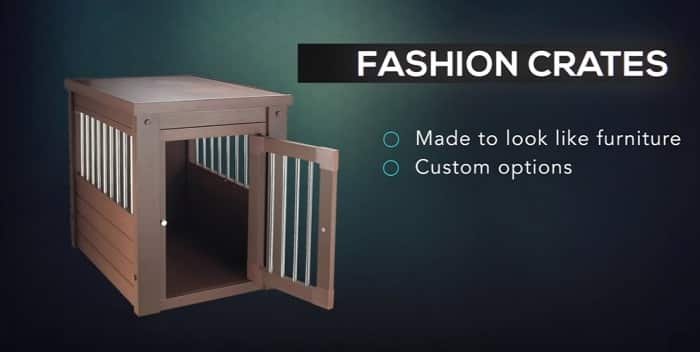
Fashion crates are made of finer grade materials and are made to look like furniture. Some are even custom integrated into existing furniture.
These are also best for a Shih Tzu that’s already accustomed to a crate. These are great for inclusion time and, as you might imagine, fashion crates tend to get kind of expensive.

Heavy duty crates are best for extended transport. They’re used mainly by owners that travel with their dogs regularly such as those that travel to competitions or trials.
These are the safest option in the car; they’re built to withstand a full-on car crash. Heavy-duty crates are amongst the most expensive of all the options.
X-pens are also a great addition to your arsenal. They’re a fabulous way-station for your integration routine. They’re awesome for puppies and small breeds. It’s a great inclusion space when you transition from a crate.
They’re movable and portable and they just fold up like a wire crate. They’re not for larger dogs or for highly energetic dogs and dogs are always supervised in these as they can learn to get out.
We typically train this too; we don’t just toss a Shih Tzu into one and hope for the best. Many puppy experts recommend that you start with both a plastic crate and a wire crate and these will be used at different times.
One is for inclusion when your dog is created but is still in proximity with the family, and one we call a “quiet crate” which is covered for, well, quiet alone time.
If you can only afford one then a plastic crate may be the better choice initially. If you’re adopting an older Shih Tzu that is crate trained a wire crate might be just fine. Once you’re through some of those tougher early phases you should be able to progress into soft sided, fashion, or heavy-duty if you desire.
The baseline is that your Shih Tzu needs to be able to stand up, turn around, and lie down comfortably in the crate. This is an easy prospect if you’re adopting an older Shih Tzu that’s pretty much done growing, but for puppies that can be a little more difficult.
Wire crates usually come with a movable divider so you can effectively start the crate small and then enlarge it as the puppy grows. This way you only have to buy one wire crate.
For your plastic crate you’ll have to get one big enough to last a little while. Ostensibly once your puppy’s potty-trained you may not need your plastic crate.
We won’t cover how to potty train your Shih Tzu in this article as we already have an article on it. If your dog has had a previous bad experience with the crate or is suffering from isolation distress or separation anxiety you will need to seek help from a trainer or behavioral consultant.
Don’t try to force the issue or you’ll just make it worse. For the rest of the dogs out there though it’s usually a pretty straightforward process. We want our dog to view the crate as a safe place. It should be pleasant and inviting, so we need to habituate them to it.
A neutral response is sufficient but a good Conditioned Emotional Response is even better. As with all training there’s a timing issue: monitor and control their energy and don’t try to work on crate training during peak arousal times. Work with them, spend time with them and wear them out first.
Your first line strategy is praise of course. As we’ve said numerous times on this channel your voice is your number one training tool. Consider using a consistent phrase as a cue to go in. As with everything in training pairing a word or phrase will help directionalize their attention towards where it needs to be.
Tie the door back initially so it doesn’t scare your dog. Doors can swing around randomly and clink and clunk on the crate potentially frightening sensitive Shih Tzus and setting your work back.
Don’t work on crate training with your Shih Tzu unless you have food rewards and toy rewards ready. Set this up and make it convenient for you or you probably won’t do it.
Routines are awesome but try not to make your initial training follow a predictable pattern. You want to destabilize the patterns of coming and going to short circuit expectation.
This will preserve the integrity of whatever training you do with the crate. Don’t let your dog make a habit of demanding to be let out if your dog is barking for you to open the door in those early phases, here’s how you fix it:
Crate training is labor-intensive but it reduces the possibility of problems later on. Be patient, practice until your dog enters their crate willingly. Depending on the Shih Tzu this could take several days.
Don’t rush it; your dog will tell you how fast to go. Practice until your dog is alright in the crate for about 30 minutes before leaving the house.
This will minimize stress when you do leave. Make the first leaving a short one, maybe an hour or so. Finally if you make a big production out of letting your dog out you potentially create a couple of situations:
1) You condition your dog to be super aroused when you let them out. These dogs will launch out of the crate at you like a torpedo.
2) The dog starts to feel like being out of the crate is better than being in the crate. These dogs will become more reluctant to go in as time goes by so be enthusiastic about getting into the crate but be just kind of neutral about letting your dog out.
Line your crate with a soft towel or mat. If your dog is chewing up beds, a towel might be a better option until chew-toy training is under wraps. Puppies being potty trained should never be created longer than they can reasonably be expected to hold it.
The general rule of thumb is one hour per month plus one. So at two months you’re looking at approximately two to three hours, three months three or four hours, four months four to five hours and so on. Until potty training is sewn up consider coming home on a lunch break or have someone let the puppy out.
Adults don’t need as many potty breaks although as we mentioned all newly adopted adult Shih Tzus should still undergo a full potty training regimen including crate confinement. Don’t leave food in the crate. There is no situation where your Shih Tzu should require food in the crate.
As we’ve mentioned many times before Shih Tzus should not be free fed, they should be on a routine, timed feedings. And your dog should never be crated so long that they require food available in the crate anyway. The only time food is available in the crate is when we’re toy-feeding them to habituate them to being inside it.
This is a temporary situation during our training progression. Water is a little different. If your Shih Tzu is only in the crate a couple of hours at a time water is not necessary, although if you’re a working stiff and your Shih Tzu spends several hours a day in there you may want to consider making water available.
In this case do not use a bowl, get a water bottle. This is a lot less messy and more compact without taking up internal real estate. However, for those Shih Tzus that spend long hours alone you may want to consider making a bigger Den Apartment.
For adult Shih Tzus you can give them more room to hang out, and the puppy version actually includes a toilet that will expedite your potty training.
We mentioned our recommendation that you have two crates initially: an inclusion crate in a room where you spend the most time and a quiet crate.
This is another method for managing energy. There will be times when your dog needs to settle down for a nap in a dark quiet place and there are times when your dog can hang out with the family but still needs to learn how to occupy themselves.
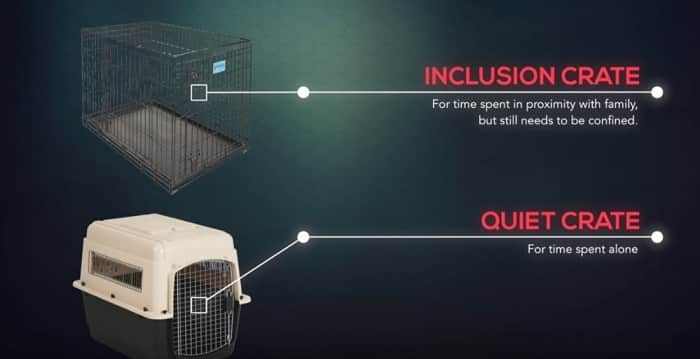
Once they’re supervised, this is a good time for a chew toy and later on this will be a good opportunity to use that X-pen. However you set things up—one crate or two—set up the flow so that you can move your Shih Tzu around easily.
Don’t put their crate in the upstairs back bedroom. Especially if you’re potty training you need to be able to get them outside quickly and easily. Set up your house to make it easy for you or you won’t get it done.
Alright guys! This should cover the majority of your crate training conundrums. If you run into any bigger snags make sure to buddy up with a local trainer to help you iron out those kinks.
This is an example post, originally published as part of Blogging University. Enroll in one of our ten programs, and start your blog right.
You’re going to publish a post today. Don’t worry about how your blog looks. Don’t worry if you haven’t given it a name yet, or you’re feeling overwhelmed. Just click the “New Post” button, and tell us why you’re here.
Why do this?
The post can be short or long, a personal intro to your life or a bloggy mission statement, a manifesto for the future or a simple outline of your the types of things you hope to publish.
To help you get started, here are a few questions:
You’re not locked into any of this; one of the wonderful things about blogs is how they constantly evolve as we learn, grow, and interact with one another — but it’s good to know where and why you started, and articulating your goals may just give you a few other post ideas.
Can’t think how to get started? Just write the first thing that pops into your head. Anne Lamott, author of a book on writing we love, says that you need to give yourself permission to write a “crappy first draft”. Anne makes a great point — just start writing, and worry about editing it later.
When you’re ready to publish, give your post three to five tags that describe your blog’s focus — writing, photography, fiction, parenting, food, cars, movies, sports, whatever. These tags will help others who care about your topics find you in the Reader. Make sure one of the tags is “zerotohero,” so other new bloggers can find you, too.

 Pet Dog FAQ